Your customers are fine talking to an AI. As long as it solves their problem, and a human is still within reach. Fin, the AI agent born at Intercom, promises exactly that, and Salesforce just paid $3.6 billion for it. What it does, how it plugs into your systems, and when to choose it over Agentforce: here’s our take, after a three-day hands-on workshop in Dublin, at Salesforce’s offices, and a demo on Salesforce.
$3.6B
what Salesforce paid for Fin, in a deal closed on September 10, 2026
The shift
An AI that acts, a human within reach
Customer service has become generative AI’s first proving ground. Leadership is pushing, volumes are rising, teams aren’t growing. Customers have a more nuanced view.
According to a Gartner survey of 3,566 B2B and B2C customers conducted in February and March 2026:
50%
of customers say interactions are easier when companies use GenAI
87%
say access to a human agent is essential
74%
of B2B customers using GenAI have already had it complete a task for them
The takeaway is simple. A good AI agent doesn’t just answer FAQs. It takes action (changing an order, updating a record, opening a request), and it knows when to hand over. That’s no longer a chatbot problem. It’s a systems integration problem.
The backstory
Fifteen years to become an agent
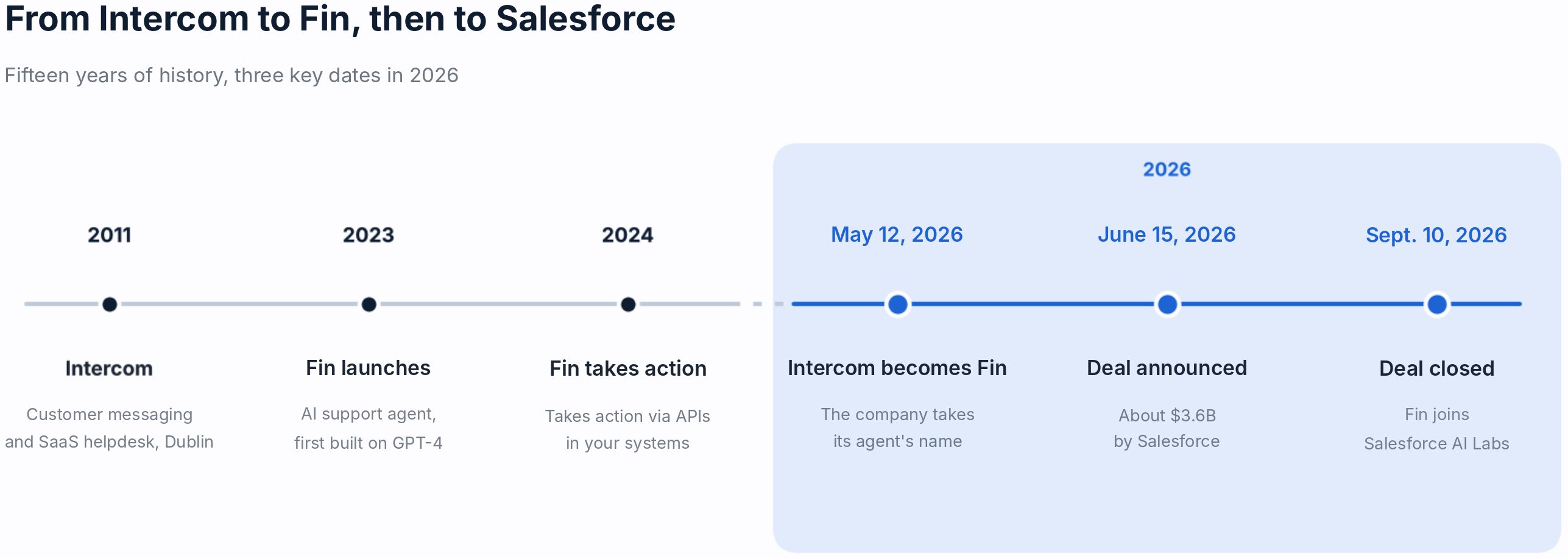
Intercom was founded in Dublin in 2011 by four Irish founders. For more than a decade, it was a customer messaging platform and SaaS help desk, known for its chat bubble in the bottom-right corner of websites.
In 2023, the company launched Fin, an AI support agent first built on GPT-4. By 2024, Fin could take action, not just answer. Intercom then built its own models, trained specifically for customer service.
The bet went all in in 2026. On May 12, Intercom renamed itself after its agent: the company became Fin. On June 15, Salesforce announced a deal to acquire it for about $3.6 billion. The acquisition closed on September 10 (Salesforce press release).
Fin brings more than 30,000 business customers and a reported average resolution rate of 76% with no human involved. It joins Salesforce AI Labs and continues to serve its existing customers.
In brief
One agent, three building blocks, every channel
Fin is an AI customer service agent, built by the company formerly known as Intercom and owned by Salesforce since September 2026, that resolves requests end to end across chat, email, messaging apps, and phone. It runs on a suite of proprietary models trained for customer experience.
The lineup covers three roles. Fin AI Agent answers customers, 24/7. Copilot assists human agents with draft replies. Operator analyzes Fin’s performance and suggests content fixes.
Setup comes down to three no-code building blocks:
01
Knowledge: what Fin knows. Help articles, PDFs, web pages, internal content. Every answer comes from here.
02
Guidance: how Fin behaves. Plain-language instructions on tone, business rules, and when to hand over to a human.
03
Skills: what Fin can do. Guided procedures and API calls to your systems, such as updating a contact record.
These blocks are shared across every channel: web and mobile Messenger, email, WhatsApp, SMS, Instagram, Slack, Discord, and voice. A customer gets the same answer whether they type or call.
Pricing
Pay per outcome, not per seat
Fin costs $0.99 per outcome, meaning a resolved conversation or a completed action. A conversation simply handed to a human, with no outcome, isn’t billed. There are two options (list prices, October 2026, Fin pricing page):
Fin on your help desk
$0.99
per outcome, no seats to pay
Salesforce, Zendesk, HubSpot… 50-outcome monthly minimum, negotiated commitments for larger volumes.
Fin + Intercom help desk
$0.99
per outcome, plus $29 per seat per month (starting price)
For teams that also want Intercom’s inbox, ticketing, and help center.
Copilot and the Pro add-on (quality analytics, Operator) are optional extras. Billing is in US dollars only, worth flagging early to finance teams outside the US.
Flexibility
It plugs into what you already have
This is Fin’s real strength. You don’t have to switch tools. Fin works with Intercom’s own help desk, but also with Zendesk, HubSpot, Freshdesk, Zoho, Front, and Salesforce Service Cloud (official list). The vendor says a first scope can be set up in under an hour.
On Salesforce, Fin handles Cases created through Email-to-Case and Web-to-Case, and can route a conversation to a human agent in Messaging for In-App and Web. To act on your systems, Data Connectors call your APIs or MCP servers (Model Context Protocol, the standard that lets an AI use external tools), as described on Fin’s integrations page.
Solganeo took part in a three-day hands-on workshop in Dublin, at Salesforce’s offices. Three days working in the product, not watching a sales pitch. We then reproduced the exercise on a Salesforce demo org. The scenario: a logged-in customer asks for the status of their file, then updates a detail on their Contact record.
01
Identify the customer. The website passes the user’s email in a signed JWT embedded in the Fin snippet. Fin knows who it’s talking to, with no extra login.
02
Connect to Salesforce. A Data Connector calls Salesforce server to server, through an External Client App. No user has to grant access.
03
Read and write. An Apex REST API takes the field and the value, reads the status, and updates the Contact record. Fin returns the result in plain language.
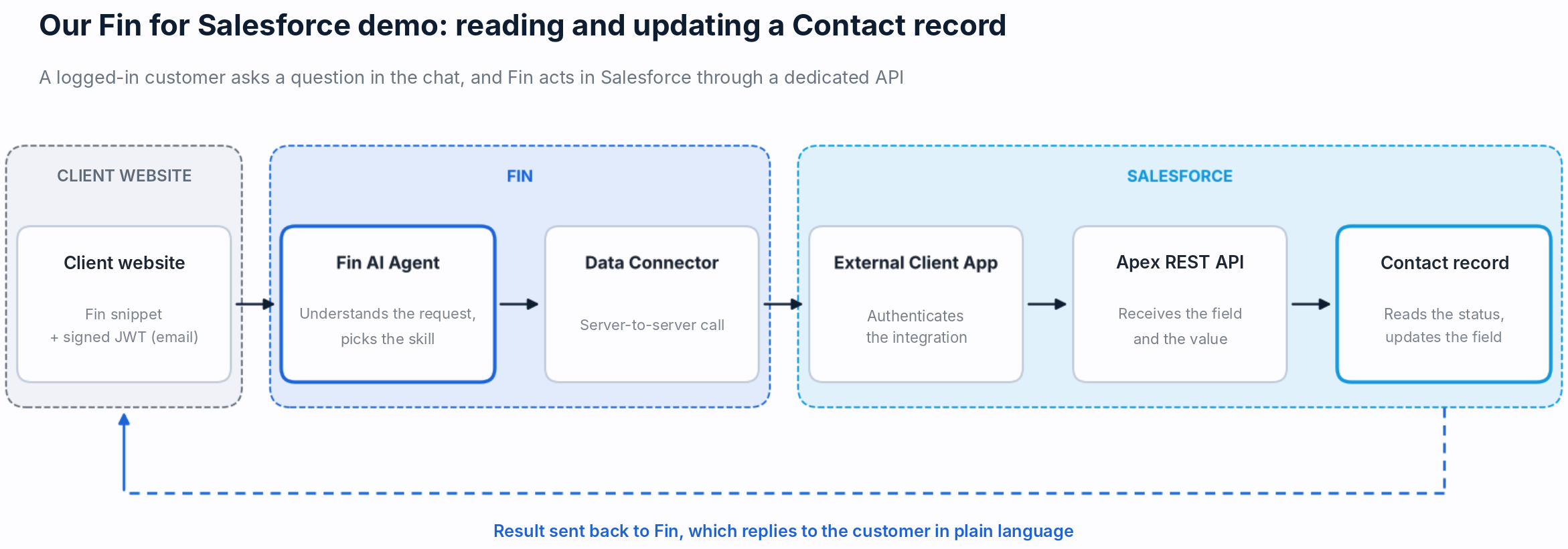
The integration work boils down to one small, well-scoped API on the Salesforce side. Fin only sees what you expose to it, which also makes the conversation with your security and privacy teams easier.
Fin or Agentforce
Two agents, two philosophies
Salesforce already has Agentforce, its platform for building AI agents at the heart of the CRM. So why buy Fin? Salesforce says it plainly: Fin brings fast deployment on existing systems, while Agentforce remains the deeply customizable platform for enterprise-scale transformation.
In practice, the difference shows from day one. Fin is managed from its own console, with plain-language guidance. Agentforce is built inside Salesforce, with topics, actions (Flows, Apex, prompts), and Data 360 (formerly Data Cloud) for customer context. More powerful, and longer to set up.
Two points matter most to decision-makers. The business model: Fin is paid per outcome, while Agentforce is bought through your Salesforce contracts, by credits or per user depending on the offer. The scope: Fin is a customer service specialist, while Agentforce also covers sales, marketing, and internal processes.
Lean toward
Fin if…
✓ Customer support is your priority, and you want a first agent live within weeks.
✓ You want to keep your current help desk, whether it’s Service Cloud, Zendesk, or another tool, or even several.
✓ You want costs that scale with resolved conversations.
✓ Your support team wants to manage the agent itself, without developers.
Lean toward
Agentforce if…
✓ The agent must orchestrate complex, multi-object processes inside Salesforce.
✓ You’re already investing in Data 360 to unify customer data.
✓ You’re targeting several functions (sales, marketing, service) on one platform.
✓ Your governance requires everything to stay inside the Salesforce org.
One question remains open: how the two offers will coexist. Since the deal closed, Salesforce has listed Fin among its ready-to-use agents, but hasn’t yet published an integration roadmap or a combined pricing model. We’re following this closely.
Watch-outs
The limits, because there are some
Pros
+ Fast to launch.
A first scope is configured without code, by the support team itself.
+ No forced migration.
Fin sits on top of your existing help desk, Salesforce included.
+ Clear pricing.
You pay for resolved conversations, not seats.
+ An agent that acts.
Data Connectors let it read and write in your systems, under your control.
+ One setup for every channel.
The same content, guidance, and skills apply across chat, email, WhatsApp, and phone.
+ Human handover built in.
Fin passes the conversation to a human agent, directly in the tool they already use.
+ Tested before customers see it.
Simulations and regression tests check Fin’s answers before each go-live.
Cons
− Voice is still young.
The phone channel exists, but we treat it as a beta.
− A plain chat interface.
No buttons, dropdowns, or rich formatting in answers.
− Quality depends on content.
An incomplete or contradictory knowledge base produces answers to match. Plan a real content workstream.
Next step
A pilot in four steps
No need for a big program. A well-scoped pilot is enough to see whether Fin delivers for you.
01
Pick a scope.
Your support team’s 20 most frequent questions, on a single channel, often chat.
02
Clean up the content.
Review the articles that answer them, remove duplicates and outdated versions.
03
Write the handover rules.
Sensitive topics, unhappy customers, out-of-scope requests: a customer must always be able to reach someone.
04
Connect one action, then measure.
A status lookup in Salesforce, for example. Track resolution rate and satisfaction for a month before expanding.
Takeaway
Fin doesn’t replace Agentforce: it offers a shorter, more focused path to AI in customer service.
For many companies, it’s the right way in, provided content and escalation rules get proper attention. Is your support team ready to hand its most frequent requests to an agent?
At Solganeo, a Salesforce consultancy and integrator, we help organizations from scoping to go-live: choosing between Fin and Agentforce, preparing content, integrating with Salesforce, and tracking results. Our recommendation: start with a demo on your own use cases.
Frequently asked questions
Your questions about Fin
Fin is an AI customer service agent that answers customers and acts on their behalf across chat, email, messaging apps, and phone. Intercom launched it in 2023 and took its name in May 2026. Salesforce completed its acquisition on September 10, 2026.
The company is now called Fin and is owned by Salesforce. The Intercom help desk is still available, with or without the Fin agent. Existing customers continue to be served.
Yes. Fin handles Cases from Email-to-Case and Web-to-Case, and hands conversations over to your human agents. Through Data Connectors, it can also read and update Salesforce data, such as a Contact record.
Fin is a packaged agent, specialized in customer service and quick to deploy on an existing help desk. Agentforce is a platform for building custom agents inside Salesforce, across every function. Salesforce positions the two as complementary.
As of October 2026, Fin costs $0.99 per resolved conversation ("outcome"), with a monthly minimum on third-party help desks. With Intercom’s help desk, add a per-seat subscription for human agents. Current prices are on Fin’s pricing page.
No, and that shouldn’t be the goal. Fin absorbs repetitive requests and frees up time for complex cases. According to Gartner, 87% of customers say access to a human agent is essential.
Sources
- Salesforce, Salesforce Completes Acquisition of Fin (September 10, 2026)
- Gartner, Gartner Survey Finds 87% of Customers Say Companies Using GenAI for Customer Service Must Provide Access to a Human Agent (August 4, 2026)
- Fin, Pricing (October 2026)
- Fin, Integrations (October 2026)
