Duplication costs more than creation
In an organization sending around a hundred emails per year, what weighs most is not graphic design. It’s maintenance. A logo change, new legal mention, footer redesign, or accessibility fix must be replicated across dozens of independent assets. Each duplication is technical debt, and each manual correction an opportunity to introduce a discrepancy.
Add to this the usual email frictions: Outlook compatibility, dark mode handling, Gmail rendering, trade-offs between drag-and-drop editor and custom code. After a few years, teams maintain a template library that no one fully understands anymore.
Maizzle, in brief
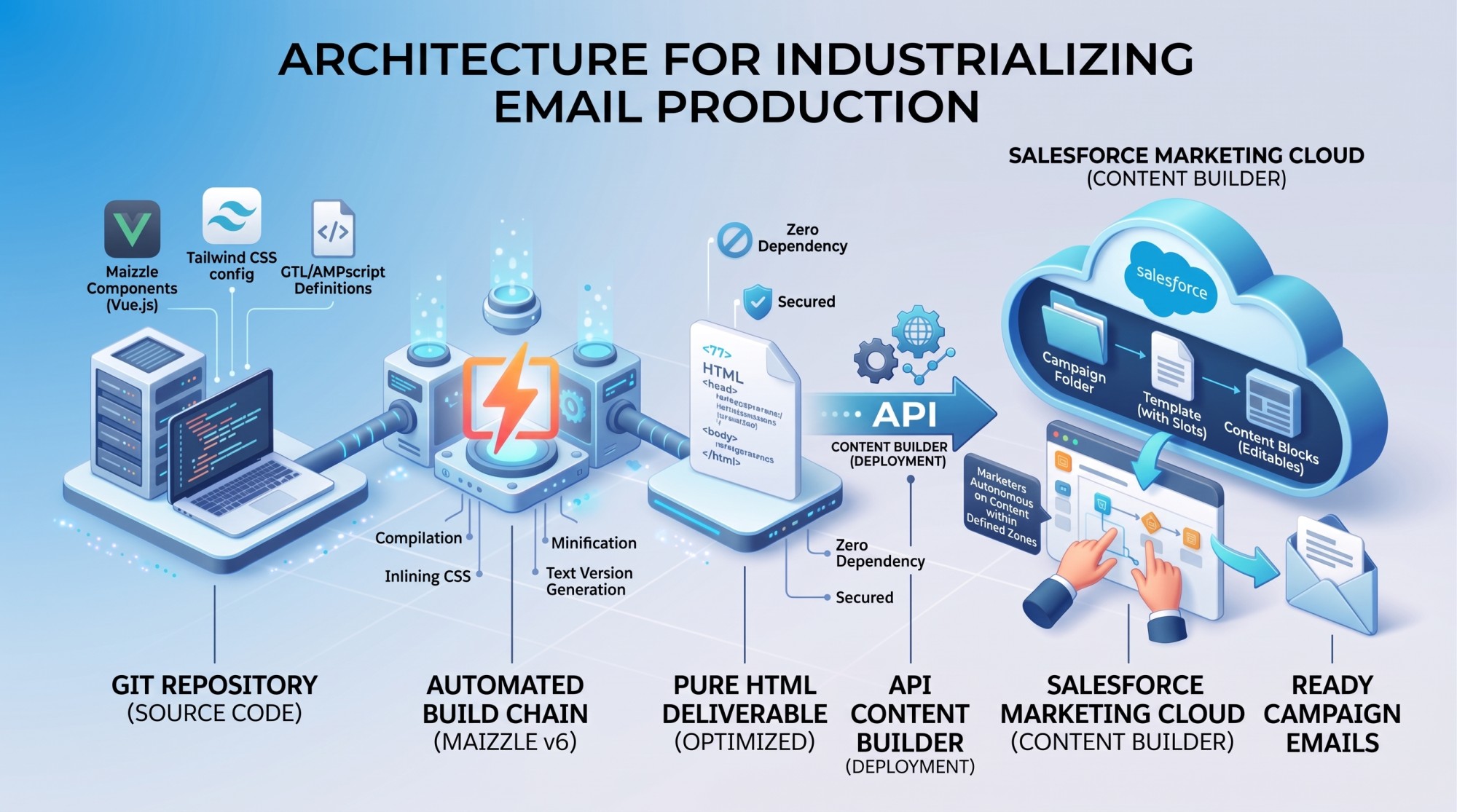
Maizzle is an open-source email development framework, now in version 6. It lets you write emails as reusable components, with v6 leveraging Vue component syntax, and style them with a version of Tailwind CSS adapted for email clients. At compilation, Maizzle produces pure HTML with no dependencies. It inlines CSS styles, removes unused CSS, minifies code, generates plain text version, and applies a series of transformations that secure rendering.
Two points directly interest decision-makers. First: Maizzle exposes a command-line interface and an API (render(), build()), making email production scriptable and therefore automatable. Second: the deliverable is standard HTML, compatible with any email platform, including Marketing Cloud. There is no technology lock-in on the output.
What compilation does
01 SOURCES
Multilingual components
Breakdown into reusable components, language management, themes and segments.
02 BUILD
Transformations
- inline CSS
- purge
- minify
- plain text
03 DELIVERABLE
Pure HTML
With no dependencies, compatible with any email platform.
CLI + API : render() · build()
Connecting to Salesforce Marketing Cloud
Marketing Cloud Engagement exposes a Content Builder API that allows creating and updating assets programmatically. Its model is hierarchical: a message can contain a template, itself an asset, which contains placeholders called slots, which are also assets. This model makes automation possible.
An industrialized pipeline works this way. Sources live in a Git repository. A modification triggers a Maizzle build. The produced HTML is pushed to Content Builder via the API, as templates or content blocks. Marketing teams then assemble their campaigns in Journey Builder from these validated building blocks. Developers retain control of rendering and marketers retain autonomy over content.
Two technical precautions structure the entire project, and they have a direct impact on budget.
- Personalization must survive the build.
AMPscript (%%[ ]%%) and personalization strings pass through compilation without major difficulty, but CSS inlining and minification can alter poorly encapsulated code. The trickiest case concerns Marketing Cloud’s Guide Template Language, which uses double braces like Handlebars. This is exactly the component interpolation delimiter. If the collision is not handled at template design, the build breaks conditional blocks. - Marketing-side editability doesn’t just happen.
An email injected as raw HTML cannot be edited in the drag-and-drop editor. For teams to remain autonomous, you must declare editable zones, slots, and blocks directly in the markup. This requires real upfront design work and analysis.
Advantages
- Traceability and rollback.
With emails versioned in Git, each modification is attributed, reviewed, and reversible. This argument carries weight in regulated sectors. - Multilingual and variants at marginal cost.
Generating twelve versions of an email from the same component becomes a build operation, instead of twelve integrations. - More consistent rendering.
Recurring issues like Outlook, dark mode, or fixed widths are solved at the component level and stop surfacing on every campaign. - Reduced timelines on repetitive campaigns.
The gain is clear on transactional emails and recurring sequences. It remains modest on unique creations. - No lock-in on the deliverable.
The output remains HTML, so switching email platforms doesn’t invalidate the investment in templates.
Disadvantages
- Developer skills become essential.
This is the most often underestimated tipping point. Without someone capable of running and maintaining the pipeline, the system degrades within months. - A breaking point between the tool and the platform.
Any evolution of Marketing Cloud’s asset model, or a major framework version upgrade, requires intervention in the integration. - Possible loss of autonomy for marketing.
If editable zones are poorly defined, every change request goes back to the technical team. This is the opposite of the intended effect. - Real initial investment.
Return on investment is measured in email volume and system lifespan, not weeks. - Low value below a certain threshold.
Below about twenty emails per year and without multilingual requirements, the native Content Builder editor remains the most rational choice.
Organizational impacts and challenges
Industrializing email production redistributes roles as much as tools. The developer becomes the design system owner. The marketing team becomes a consumer of validated components. Graphic validation moves upstream, to the block level, rather than email-by-email. This shift is generally the real difficulty of such a project, well before the technical aspects.
Three questions deserve to be decided before starting.
01
Who has the right to modify a shared component, and through what validation process?
02
What zones are open to marketing and which are locked?
03
What happens if the person who understands the pipeline leaves the organization?
Without documented answers to this last question, the system remains fragile.
Costs to anticipate
The framework is free. The cost lies elsewhere and breaks down into four areas.
01
Setup.
Email design system conception, component development, build and deployment configuration to Content Builder, multi-client rendering tests. This is the main cost, and it depends mainly on the number of templates to cover.
02
Marketing Cloud integration.
API access management, personalization handling, editable zone definition, testing with campaign teams.
03
Recurring maintenance.
Version upgrades, brand evolution, fixes related to email client behavior changes. Budget this annually, not as a one-time cost.
04
Change management.
Team training, documentation, definition of validation processes. This is the most often forgotten cost, and its absence is enough to make the project fail.
To these internal costs, add, as applicable, a multi-client rendering test tool and continuous integration infrastructure. [Indicative pricing to be completed with magnitudes observed on your projects: days per area and profitability threshold observed.]
Should you go for it?
The approach is justified when several conditions are met: significant and recurring email volume, multilingual or multi-brand needs, compliance requirements that demand traceability, stable brand guidelines, and ongoing developer expertise, either in-house or through a partner.
Yes if
Significant recurring volume, multilingual needs, traceability required and guaranteed presence of ongoing technical resources.
No if
Low production (< 20 emails/year), unique repetitive creations, or lack of technical resources: the native editor remains preferable.
At Solganeo, we help organizations navigate these decisions: needs scoping, profitability threshold evaluation, email design system conception, and Salesforce Marketing Cloud integration.
If this question comes up in your organization, start with an audit of your template library. That’s where the answer usually appears.
Frequently asked questions
No. Maizzle produces the HTML for emails. Marketing Cloud remains the platform that manages data, journeys, and sends. The two are complementary.
Yes, as long as editable zones have been declared in templates as slots and blocks. This is a design choice to make at the project start.
Yes. AMPscript code passes through compilation as long as it’s properly encapsulated to avoid being altered by CSS inlining or minification. The main concern is Marketing Cloud’s Guide Template Language, whose delimiters can conflict with the framework’s. If this collision is not handled at template design, the build breaks conditional blocks.
Lack of ongoing technical resources to maintain the pipeline, and poorly defined governance between technical and campaign teams.
