
You picked the right platform, lined up a budget, and set a go-live date. And still, a large share of CRM projects disappoint. The software is almost never to blame. What happens before the first line of configuration, the discovery phase, decides the rest. Here’s what it reveals, and how to run it.
The problem
The software is almost never the culprit
Analyst firms have said it for more than twenty years: a large share of CRM projects never meet their objectives. The exact figure varies by study, but the finding doesn’t budge. The famous "80% fail" is mostly folklore; the documented reality is lower, and still troubling; it repeats year after year.
According to analyst estimates widely cited across the industry (see Salesforce’s own summary of why CRM projects fail):
30 to 50%
of CRM deployments fall short of their objectives
~50%
underperform within the first two to three years
The number one cause
is almost never the tool
What these failures share is not technology. It’s usually a fuzzy strategy, processes that were never mapped, poor-quality data, and absent change management. All of which is decided, or neglected, long before anyone opens the platform.
The real problem
Teams build fast what no one actually defined
The pattern is almost always the same. The team pictures the target solution, then rushes into configuration. Requirements get gathered from management, rarely from the people handling leads all day. And the CRM ends up configured to match the org chart rather than the real process.
The result: a technically clean tool that no one uses as intended, because it answers an idealized version of the business instead of how it actually works day to day.
A requirement is not a wishlist. It’s a business problem, described by the people who live it.
What discovery is
An information-gathering phase, not a formality
Discovery is the stage that comes before any analysis or configuration. Its goal is simple: to gather everything needed to make the best possible recommendations. Not to produce one more document, but to give every decision in the project a solid foundation.
Done well, discovery lays the groundwork for everything that follows: analysis, design, then build. Rushed, it leaves gaps the project pays for later, at a premium.
The method
Interview the whole chain, not just the sponsor
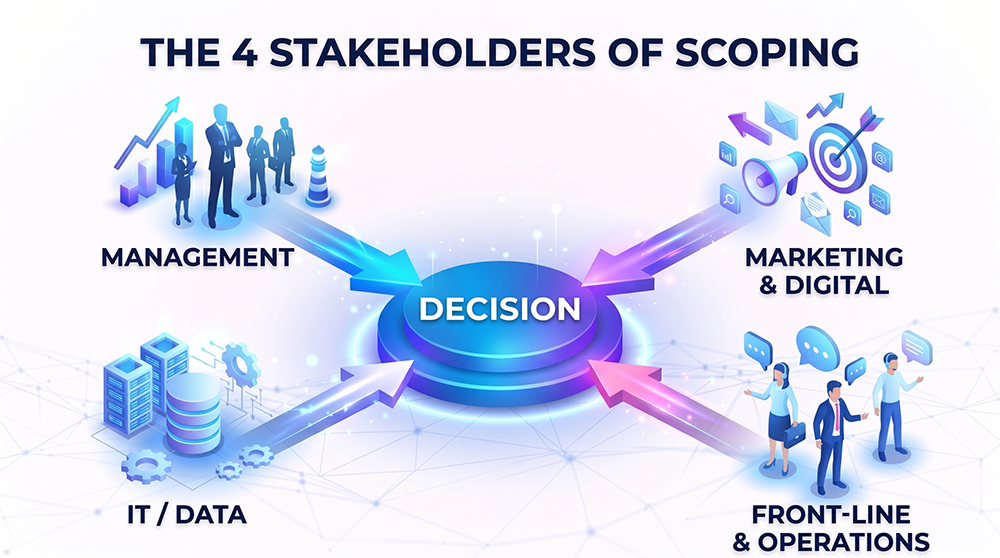
Good discovery isn’t one meeting with the decision-maker. It goes looking for the truth where it lives: at every link in the chain that touches the customer lifecycle.
01
Leadership
The business vision, the strategy, the objectives for the next few years, and the success metrics expected.
02
Marketing / digital
The acquisition strategy, the channels, the journeys, how data is collected and activated.
03
IT / Data
The application ecosystem, the data model, the integrations, governance, and data quality.
04
The field
Sales, call center, customer service: what actually happens, lead in hand, with the real tools in view.
Each describes a partial reality, often sincerely convinced it’s the whole picture. The gaps between these accounts are the project. The reporting leadership believes is "precise" may feel random on the floor; an integration the business considers "in place" may only half-exist on the IT side. That’s exactly what discovery surfaces.
The questions
Questions that chase the process, not the feature
The quality of discovery comes down to its questions. The best ones don’t ask which feature you want, but how you work today and where it breaks.
01
Strategy and objectives
What is the CRM for? What value should it deliver?
You’re after intent, not a list of modules.
02
Success metrics
How will you know the project succeeded? Which KPIs, measured how, from which baseline?
Without a starting value, no improvement can be proven.
03
Today’s challenges
Where does it actually break?
Steering, tracking, data quality, coordination between teams… The real problems are rarely the ones anyone anticipated.
04
Data and governance
Which objects, which uniqueness and deduplication rules, which integrations, what quality?
This is where feasibility is decided.
05
The journey, today and tomorrow
Map the current state and the target, from awareness to retention, through acquisition, onboarding, engagement, and loyalty.
The question that reveals the most isn’t "what do you want?" but "how do you do it today?"
Watch-outs
What makes discovery fail
Discovery can exist on paper and be worthless. The most common traps:
Trap 1
Interviewing only management
You get the vision, not the operational reality, and operations are what make or break the tool.
Trap 2
Mistaking wishes for requirements
A list of features with no prioritization and no underlying problem is not a spec.
Trap 3
Skipping data and integrations
The data model and the data flows decide feasibility. Ignore them and you’ll discover the blockers once the build is underway.
Trap 4
Not defining success
With no metrics and no measured starting point, you can’t prove the project’s value.
Trap 5
Underestimating logistics
Teams are busy: discovery has to be prepared and scheduled in advance, or it drags on for weeks.
Trap 6
Treating it as a box to tick
Discovery is only worth the analysis and decisions that follow it.
Let’s be honest
Discovery adds time up front.
It always costs less than a project you have to rebuild.
Next step
One step you can take on your own
Before your next CRM project, take half a day and produce four pages:
- The stakeholder list. Everyone who touches the lead and customer lifecycle, from leadership to the field to IT.
- The customer journey, current and target. One page, from awareness to retention.
- The application inventory. The apps around the CRM and the data flows that connect them.
- Three success metrics, each with its starting value.
If those four pages exist and hold up, you’re ready to configure. If they don’t, you just avoided the wall.
Takeaway
A CRM project is won or lost long before the first line of configuration
Discovery isn’t a box to tick; it’s the project’s insurance policy. At Solganeo, a Salesforce consultancy, we start every engagement there: interviews across the whole chain, application and data-model mapping, current and target journeys, success metrics.
Launching or relaunching a CRM project? Let’s start by laying the foundations.
FAQ
Your questions about CRM discovery
It’s the information-gathering stage that comes before analysis and configuration. It brings together the business vision, the real processes, the data, and the technical constraints, so recommendations rest on facts rather than assumptions.
Rarely because of the software. Most often because of a fuzzy strategy, unmapped processes, poor data quality, absent change management, and success metrics that were never defined.
The whole chain: leadership for the vision, marketing and digital for the acquisition strategy, the field (sales, call center, customer service) for operational reality, and IT/Data for the ecosystem and the data model. The gaps between these accounts are often the heart of the project.
From a few days to a few weeks, depending on the project’s size and the number of stakeholders. It’s a short investment against the cost of rebuilding a project.
A wishlist is a set of desired features with no priority and no justification. A requirement describes a concrete, measurable business problem, lived by a team. You build from requirements, not from wishes.
